The Ten Billion Dollar Deficit: The Economic Burdens of Inequities Across California Schools
Summary
New research reveals the massive costs of high school non-completion, absenteeism, and school discipline across the nation’s largest economy: California.
A new cost-benefit analysis from our CA Multi-Tiered System of Support (MTSS) Research Consortium partners at the Penn Center for Benefit-Cost Studies of Education quantify the long-term economic impact of educational disparities across the state of California. The analysis shows how dropout rates, chronic absenteeism, and exclusionary discipline lead to billions in lost earnings and increased public spending—burdens to families, schools, and taxpayers that vary by race and student disadvantage.
California’s Multi-Tiered System of Support (MTSS) offers a path forward. With its focus on early intervention, data-driven decision making, and tiered support, MTSS not only improves student outcomes—it also delivers strong fiscal and social returns. Learn how investing in MTSS can advance both equity for students and economic prosperity for California.
Economic Gains from More High School Graduates in California
$478,000
Social gain per extra California high school graduate
$9.57 billion
Social savings if the statewide high school graduation rate increases by 3 percentage points
$2.95 billion
Taxpayer savings if the statewide high school graduation rate increases by 3 percentage points
Social Burdens per Student Status in California
$5,630
Chronic absentee
$27,260
Suspension
$70,870
Expulsion
$6,040
Disciplinary restraint
Burdens and Policy
Burdens Across Student Groups
These economic burdens do not fall equally on all student groups. The economic burdens of absenteeism and discipline disproportionately impact African American, Hispanic, and economically disadvantaged students. Table 7 in the report shows striking disparities. For African American students, family burdens are up to 11x higher, school burdens up to 26x higher, and fiscal burdens up to 17x higher than the state average. Burdens are also relatively high for Hispanic and economically disadvantaged families.
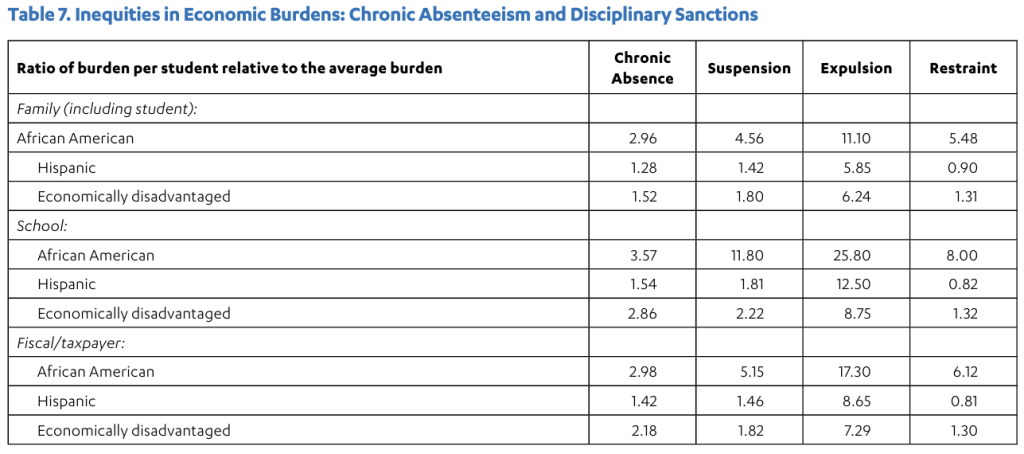
Why these gaps? These groups are more likely to face absenteeism or discipline, earn less as adults, and attend schools with fewer available school resources and smaller tax bases to obtain public funding. These three perspectives (family, school, and fiscal) show the various ways in which inequities in discipline are tied to inequities in public support for education.
Economic Equity Burdens and K–12 Funding in California
Recent changes to California’s school funding formula are intended to close resource and achievement gaps between student groups. Even as these changes are effective, they are likely to be inadequate to fully offset inequity burdens.
-
Funding is imperfectly targeted. The funding formula does not adequately recognize substantial peer effects: absenteeism and disciplinary sanction impose resource burdens across all students, not just those who are absent or disciplined. Also, district-level funding overlooks school-level needs, leaving high-burden schools under-resourced. As a result, almost one-quarter of all suspensions are “unfunded”.
-
Disparities outpace dollars. For African American students, just the cost of absenteeism and disciplinary sanctions consumes 27% of their “extra” funding. Similar burdens exist for Hispanic (18%), low-income (24%), and English Learner (46%) students.
-
The burden is growing. As student diversity increases and economic gaps widen, educational inequities and their costs are likely to rise. Communities with high economic-inequity burdens likely have a smaller local tax base; fewer economic opportunities to motivate students to acquire skills; and fewer family resources to support education. These communities face dwindling resources but growing burdens.
Related Work