
Computational Thinking Equity Project (CTEP)
About the Project
How can Computational Thinking (CT) provide a foundation for computer science and other STEM careers for students who are currently under-represented in STEM fields?
Today, Black and Latinx workers are severely underrepresented in computer science, engineering and other STEM fields.
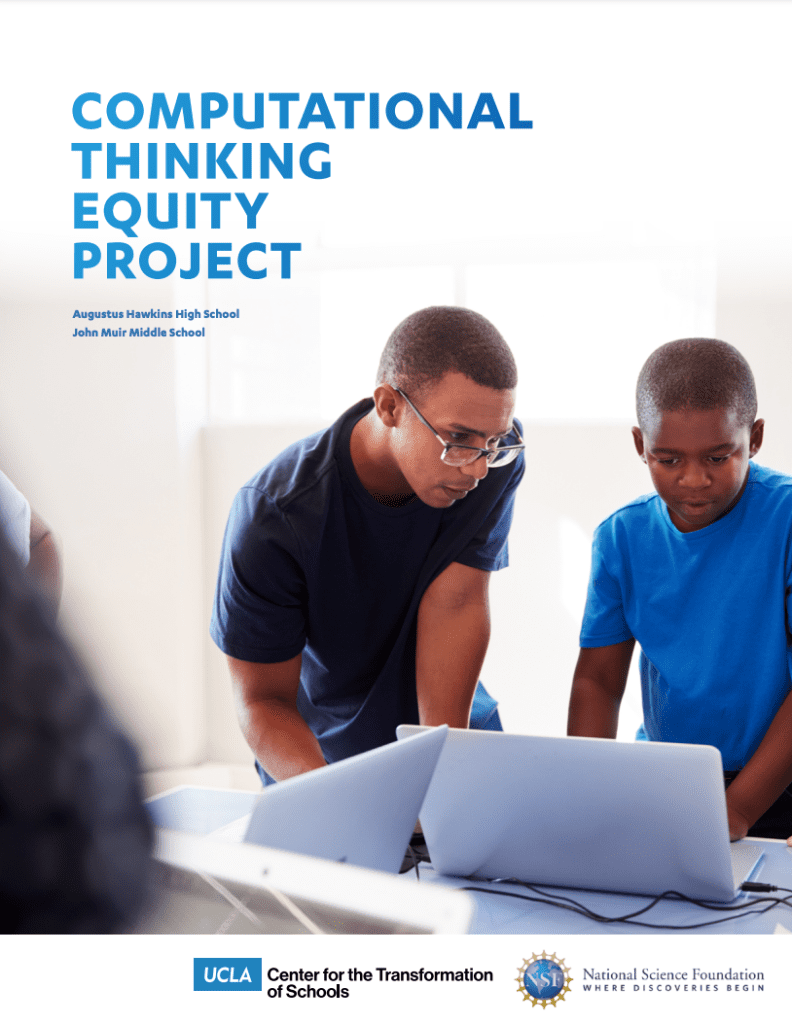
This National Science Foundation (NSF) Research Practice Partnership (RPP) aims to build a STEM pathway and pipeline between a middle and high school in South Los Angeles that centers teachers and near-peer mentoring to foster Computational Thinking, or helping students learn how to solve problems and explain solutions.
Through an initial pilot project funded by the National Science Foundation, we learned important lessons about the role of culturally-relevant approaches to students and the critical role of mentors in supporting students.
Our program is now expanding to include 300 students, their teachers, administrators and mentors from undergraduate STEM programs at UCLA.
Journal Publications
Computer science identity development among black and latinx males
Published in Educational Research
CTS Scholar Affiliate Kirk D. Rogers, Ph.D.
CTS Senior Project Scientist Stanley L. Johnson, Ph.D.
Shifting pedagogically: Incorporating the social, cultural, and emotional dimensions of student learning to develop STEM-identities in computer science
Published in Journal of Applied Developmental Psychology
CTS Senior Project Scientist Stanley L. Johnson Jr., Ph.D.
CTS Executive Director Joseph P. Bishop, Ph.D.
CTS Scholar Affiliate Kirk D. Rogers, Ph.D.
Computational Thinking Equity Project (CTEP) Logic Model

Project Brochure
Mentor Blog Series
UCLA undergraduate engineering students share about their experiences mentoring in an Algebra 1 class in South Los Angeles with CTS’s Computational Thinking Equity Project.
Victoria Madu: “Engaging Students in Computational Thinking”
Vladimir Blas-Aquino: “Empowering Students through STEM Mentorship”
Kelvin Chung: “Breaking Down Problems into Simple Steps”
Megan Young “Problem Solving as a Skill for Life”