California Race, Education, and Community Healing (REACH) Network Baseline Report
Introduction

Our baseline report from Year 1 of the Race, Education, and Community Healing (REACH) Network, a collaborative initiative co-led with UC Berkeley’s Center for Research on Expanding Educational Opportunity (CREEO), explores discipline disparities across 10 diverse California schools. Further, the report highlights each LEA’s efforts to address exclusionary discipline and provides lessons and recommendations that can inform similar efforts at other schools.
We provide valuable suspension data by race, gender, and student group and key findings from Year 1. In their approaches, we share the practical tools being used to promote healthier relationships and address inequities in school discipline that disproportionately affect students of color.
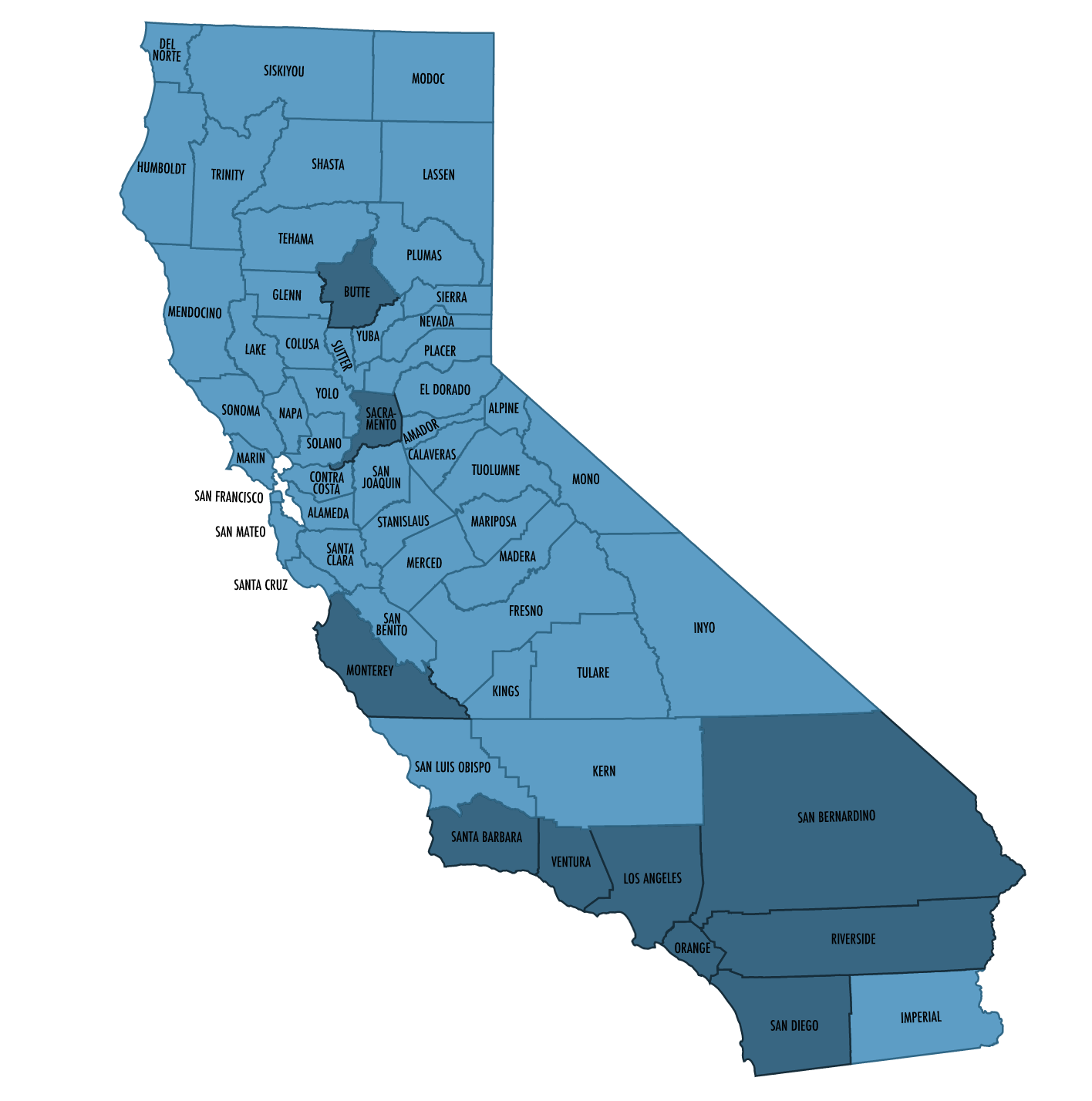
REACH Network Grantee Map:

Key Findings
Persistent and multifaceted disparities in discipline practices and policies exist across REACH Network sites.
While showing some signs of improvement, the disparities continue to disproportionately impact specific student groups by: race, disability status, gender, and socioeconomic background.
The impact of COVID-19 on discipline rates reveals both disruptions and reversions to pre-pandemic patterns.
Despite an unprecedented disruption, pre-existing patterns quickly re-emerged as schools returned to in-person operations.
Patterns of suspension disproportionality, particularly affecting Black students, persist across REACH Network sites.
Black students are consistently overrepresented across all suspension categories from 2017-18 to 2022-23.
REACH Network schools serve predominantly nonaffluent, historically marginalized student populations.
REACH Network school sites encompass a range of cultural backgrounds, with significant representation from Latinx communities and students from varied socioeconomic backgrounds. These schools confront tangible challenges, including below-average academic proficiency rates and high levels of chronic absenteeism.
Approaches To Address Exclusionary Discipline
The REACH Network schools have begun adopting innovative approaches to address disciplinary challenges, demonstrating a shared commitment to fostering positive, equitable learning environments.
Approaches include:
Cultivating a culture of empathy and support
Family and community engagement
Data-driven decision-making
Empowering educators through targeted professional development
Key Lessons from Year 1 and Recommendations for Year 2
Drawing on our Year 1 findings, a systematic literature review, innovative strategies proposed by participating schools, thorough analysis of data and artifacts, and reflections from our CoP sessions, we offer the following lessons and recommendations to guide the REACH Network’s second year of implementation:
Lesson 1: REACH LEAs demonstrate a strong commitment to transformation.
Lesson 2: Data has untapped potential as a catalyst for change.
Lesson 3: Strong leadership is essential for successful implementation.
Lesson 4: Sustaining momentum requires ongoing support.
Lesson 5: Consistency in deliverables is critical for measuring progress.
Lesson 6: Collaboration is a valued and strengthening asset.
Recommendation 1: Secure multiyear funding and expand resources to sustain and scale the reach network’s impact.
Recommendation 2: Implement comprehensive, whole-school restorative practices.
Recommendation 3: Invest in robust, culturally responsive professional development for all school staff.
Recommendation 4: Leverage data-driven decision-making.
Recommendation 5: Enhance family and community engagement.
Recommendation 6: Align with and enhance state initiatives.
Recommendation 7: Address implementation challenges.
Recommendation 8: Focus on equity and cultural responsiveness.
Recommendation 9: Commit to long-term, systemic change
School Profiles
The California Race, Education, and Community Healing (REACH) Network, launched in late 2023, unites UCLA’s Center for the Transformation of Schools (CTS) and UC Berkeley’s Center for Research on Expanding Educational Opportunity (CREEO). This collaborative initiative brings together 10 Local Education Agencies (LEAs) committed to reforming exclusionary discipline practices through data-driven, restorative-focused, and equity-centered strategies.
Within each participating LEA, one school site was selected as a focal point for implementation, given limited funding. The following School Profiles offer a candid look into these 10 selected sites, illuminating the complex realities they face. Each profile highlights:
- Demographic data
- Academic performance indicators
- Chronic absenteeism rates
- Suspension rates and patterns
- Discipline Disparity Ratio analysis
- Specific REACH Network initiatives
These snapshots reveal both persistent challenges and promising steps forward, showcasing how REACH strategies are implemented at the school level. They highlight the dedication of educators, administrators, and students working towards positive change. You’ll gain insight into the multifaceted realities of these schools and the thoughtful approaches addressing longstanding disparities in discipline practices and outcomes.
Please note: the school profiles complement the full REACH Network Baseline Report, which provides a comprehensive overview of the network’s goals, methodologies, and initial findings. Together, they offer a holistic view of California’s evolving approach to school discipline and the REACH Network’s role in fostering more equitable learning environments.
The participating schools include:
-
Crete Academy, Los Angeles County
-
Elkhorn Village Elementary, Washington Unified School District
-
El Roble Intermediate School, Claremont Unified School District
-
James Lick High School, East Side Union High School District
-
J.C. Montgomery School, Kings County Office of Education
-
Leadership Public Schools Richmond
-
Longwood Elementary, Hayward Unified School District
-
Major General Murray High School, Vista Unified School District
-
Para Los Niños Charter Middle School
-
STEAM at La Presa, La Mesa-Spring Valley School District