

Engaging Students in Computational Thinking
by Victoria Madu
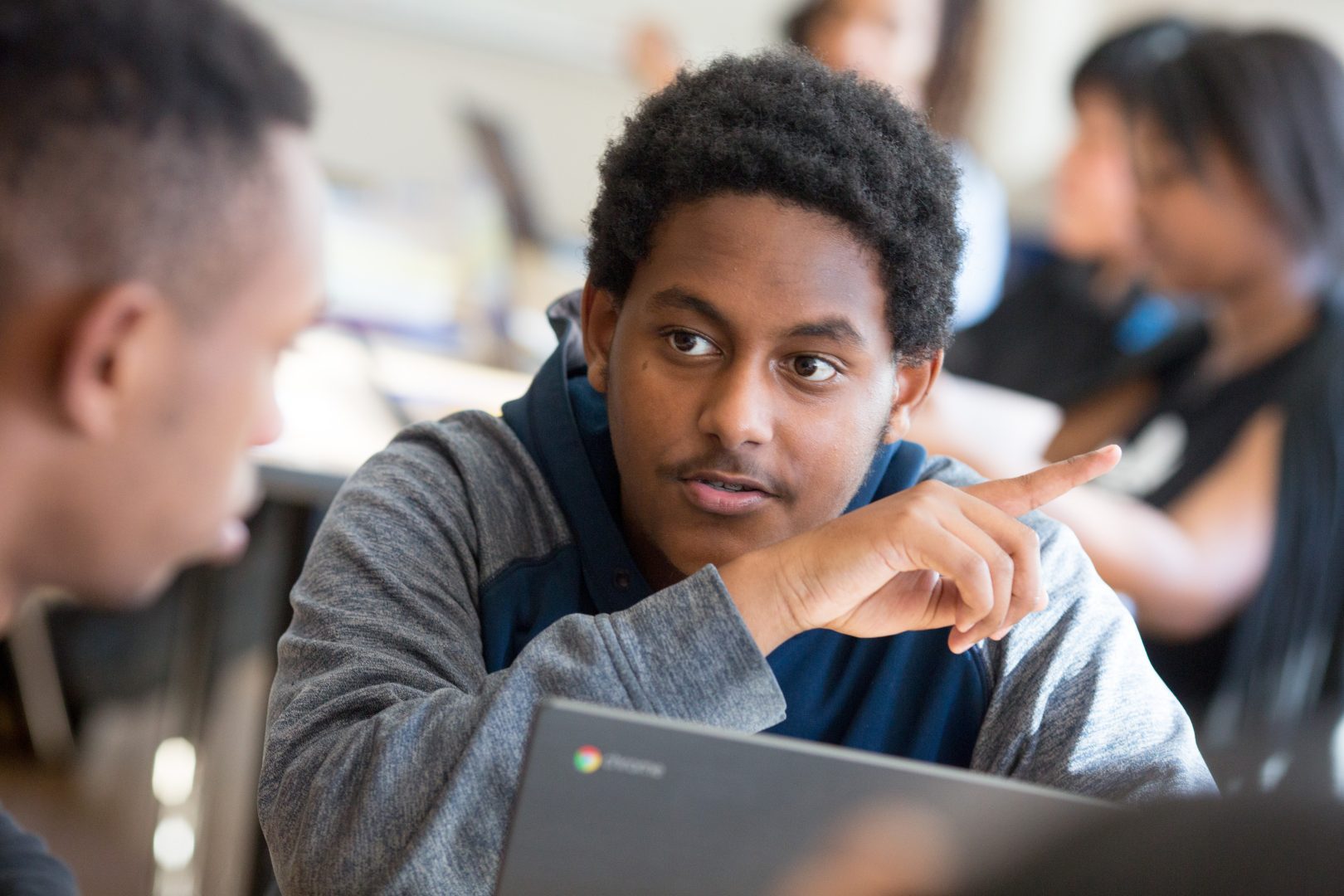
After graduating from high school in June 2023, I re-entered the high school environment to support Algebra 1 classes at Augustus Hawkins High School. I remember being both scared and excited to start–not really knowing exactly what I would be doing during my first day as a near-peer mentor. But over a few short months, I grew more comfortable and confident as not only a tutor, but an ‘accountability officer’, listening ear, and even an older friend to different students in each class that I worked in. I met students who reminded me of my younger brothers, my college and high school friends, and parts of myself. Some made me feel particularly welcomed, whether by complimenting me or feeling comfortable enough to call “Miss!” whenever they needed my help.
While I started this process feeling shy, I found success in mentoring when I was intentional in taking initiative. As a student myself, I was all too familiar with the habit of not exactly understanding something in class, but either not caring enough or feeling too drained to ask for help. At the same time, however, I was very familiar with the consequences. Being intentional often looked like scoping out the students who looked confused or disengaged, and then asking them questions. It would usually start with a simple check-in like, “Are you good?”. This would often prompt a “no” or head-shake, and then I would troubleshoot and support them from there. If the student affirmed they were okay with the material, I would ask more specific questions about the content, or ask to work through a problem with them. I learned the most important thing about mentorship is being able to empower students in their own abilities to engage in computational thinking (CT). While CT is a great strategy, students must be the ones to use it themselves.
CT as a learning strategy is a beautiful way of explaining what we all do when working through difficult problems. We decompose the issue, abstract important information from it, recognize patterns in which similar issues have been solved, and utilize step-by-step algorithms to solve it. While teaching and using CT in Algebra, I found that all of these aspects served different purposes. For example, I used decomposition often in helping students understand very loaded and abstract concepts, like multiplying and factoring polynomials. It helped them to understand the shortcuts they learned to use later, and even how to derive shortcuts by themselves. Pattern recognition was used to remind students of the principles they already learned but either forgot or didn’t know how to apply in various situations. I showed them the importance of memorizing useful tools to help solve the problems. I posed step-by-step questions to students as they were problem-solving so they could sit and think about what exactly they were doing as they carried on.
In my time as a mentor, I had a lot of fun building relationships with students and supporting them in their endeavors to take control of their education. I am grateful I was able to push students to be as great as I knew they could be. One of my happiest moments was watching the students take a quiz and seeing an improvement in their grades. Being involved in the Computational Thinking Equity Project (CTEP) has given me a new lens to reflect on my own experiences in the classroom, as well as our education system as a whole. Experiencing high school from the side of educators rather than students has deepened my passion for equity in education, especially in the STEM fields. Having excelled academically at a racially mixed high school, I remember feeling more and more isolated from other Black and Latinx students as I advanced academically. However, it was very eye-opening to me to see some of the students I was mentoring have such low self-confidence and learning some of the external factors affecting their abilities to be present in class. I hope this passion is something I’ll be able to address now and in the future by bringing more understanding to my education and my other community-serving roles.

At UCLA CTS, Victoria Madu works as an Undergraduate Mentor providing Near-Peer Mentorship at Augustus Hawkins High School under the Computational Thinking Equity Project (CTEP). Victoria is a first-year chemical engineering student at UCLA’s Samueli School of Engineering. Prior to working at CTS, she led various activities in her high school such as Step Team, Women’s Empowerment club. She continues to seek similar valuable experiences as a Pre-Collegiate Initiatives intern with UCLA’s NSBE chapter, a mentor to black girls in Compton, CA with CRWND, Inc. Mentoring Organization, and a Project Manager with AIChE at UCLA’s LEAP Project. Originally from New York, Victoria hopes to fully embrace the Los Angeles community both in and outside of UCLA while sharing her love of STEM with others from underrepresented backgrounds. Victoria has future goals of using engineering to transform the future of hair care for other black women like herself, but also hopes that through mentorship, she can help transform STEM.